ShareThis

Saturday, October 8, 2011

The revolutionary role of Islam – I

As a result of ignorance the evil known as the worship of natural phenomena was born in human society. Man attributed divinity to mere creatures. He began to worship all the things in the world, holding them to be gods. Owing to this intellectual aberration, idolatry became a rooted feature of human civilization. Not even the coming of thousands of Prophets and reformers could bring about any change in this state of affairs, in the practical sense. The rejection of the Prophets brought down on the deniers the chastisement of God, but shirk (idolatry) could never be wiped out from society. Then God Almighty took it upon Himself to intervene. One major manifestation of this Divine intervention in human history was the emergence of the Prophet Muhammad, salallaahu alayhi wa sallam. An American encyclopedia has very appropriately described his coming as having “changed the course of human history.”
French historian, Henri Pirenne, has expressed it thus: ‘Islam changed the face of the globe. The traditional order of history was overthrown.”
The Quran, in defining the objective of the divine intervention, has this to say (what means): "It is He that has sent forth His Prophet with guidance and the true faith, so that he may exalt it above all religions. God is the All-sufficient witness." [Quran 48:28]
This has found expression in a hadith recorded in Saheeh Al-Bukhaari: "He will not depart from this world as God has decreed, unless and until these people are brought to the straight path."
This shows that, for the Prophets of the past, may Allah exalt their mention, communication alone was required, whereas for the Prophet Muhammad, salallaahu alayhi wa sallam, not just communication but also implementation was required.
The task of the earlier prophets was completed with the full communication of the message to the people. But the Divine plan in sending the Prophet Muhammad, salallaahu alayhi wa sallam, to the world was to bring about a practical revolution. His message could not, therefore, remain at the theoretical stage.
It being beyond human capacity to make the end result a certainty, how was the Prophet’s, salallaahu alayhi wa sallam, message to be translated into reality? It all became possible due to the special Divine succor extended to the Prophet, salallaahu alayhi wa sallam, by God Almighty. This took the form of a Divine plan which had two basic aspects to it: one, to provide the Prophet, salallaahu alayhi wa sallam, with a powerful and trustworthy team, and the other to significantly weaken the enemies of monotheism by means of a special strategy, so that the Prophet, salallaahu alayhi wa sallam, and his companions  may  Allaah  be  pleased  with  them could easily dominate their opponents.
The first part of this Divine plan was brought to completion in the form of the settlement of Ismaa’eel, son of Prophet Ibraaheem, may Allaah exalt their mention, in the unpopulated desert of Arabia, two thousand five hundred years ago. At that time it was a totally isolated place situated far from the centres of civilization. There, a community was raised by Ismaaeel ibn Ibraaheem, may Allaah exalt their mention, trained in the desert atmosphere where there was nothing save nature. As a natural result of this unadulterated atmosphere, (free from all man-made pollution,) the human qualities of the inhabitants of the desert were fully preserved. It was like a vast natural training camp. It took more than two thousand years to evolve a nation of such high calibre as to be called a “nation of heroes” by a western scholar. In the history of the Arabs, this nation is known as the Ismaailites. Despite religious perversion having set in, so distinguished were they in human values—thanks to their particular training—that they had no peers among those who came before or after them.
The Prophet Muhammad  sallallaahu  `alayhi  wa  sallam ( may  Allaah exalt his mention ) one of the distinguished members of the Banu Ismaa’eel, struggled for about thirteen years in Makkah and ten years in Madeenah. Ultimately, more than one hundred thousand people believed in him and joined his mission. Each and every one of his companions  may  Allaah  be  pleased  with  them possessed a strong and dependable character. In this way, the Prophet Muhammad  sallallaahu  `alayhi  wa  sallam ( may  Allaah exalt his mention ) in an exceptional way, secured a team by which he could bring the message of the Prophets, may exalt their mention, to fruition—taking the prophetic mission from the theoretical stage of ideology to the practical stage of revolution.
The next part of this Divine plan consisted of weakening these anti-monotheism forces so considerably that the last Prophet might subjugate them and usher in the desired revolution in the very first generation itself. To achieve this end, the Arabian tribes remained engaged for a long period of time in bloody, internecine warfare. Consequently, when the Prophet Muhammad  sallallaahu  `alayhi  wa  sallam ( may  Allaah exalt his mention ) was sent to the world, the idolatrous tribes of Arabia, having so weakened themselves, could not continue their resistance for long. This enabled the Prophet Muhammad  sallallaahu  `alayhi  wa  sallam ( may  Allaah exalt his mention ) to overcome Arabia and root out idolatry completely within a short period of time.
In those days there were two great empires outside of Arabia. These empires kept the major parts of Asia and Africa under their full control. Their power was so great that the Arabs could not even have dreamed of overcoming them. Despite this extremely out of proportion difference, how did it become possible for the Arabs of the very first generation, to conquer both these empires—the Sassanid and Roman—in such a decisive way as to crush them absolutely, resulting in the dominance of monotheism over idolatry throughout this region? This miracle became a reality owing to a special Divine strategy, which is paralleled by the case of the Romans:
Allaah Almighty Says what means:"The Romans have been defeated in a neighbouring land. But after their defeat they shall themselves gain victory within a few years." [Quran, 30:1-3]
History shows that from 602 to 628 A.D., extremely extraordinary events took place between these two great empires.
First, the royal families in the respective countries clashed internally with one another, and in consequence, many individuals of great political worth were killed. In fact, these feuds gave a death blow to these empires, shaking them to the very roots. Subsequently, certain factors led to the destructive collision of these empires with one another. First the armies of the Sassanid empire crossed the border of the Roman empire to attack it. Circumstances proved favourable and they succeeded to the extent that the Roman Emperor Heraclius decided to flee from his Palace in Constantinople. But again, events took a new turn. Heraclius regained his lost confidence and after making full preparations, attacked the Sassanid empire, destroyed their armed forces and penetrated right into the heart of Jerusalem.
These civil wars, lasting for about twenty five years, considerably weakened both these empires. Therefore, during the pious caliphate when the Arab forces entered the Roman and Sassanid empires, they managed to advance with great speed.

The revolutionary role of Islam – II

Historical revolution
This expansion of the Islamic empire was not simply a political event. Its aim, in fact, was to set in motion a revolutionary process in history. This process had been initiated in Makkah itself, then it travelled from Makkah to Madeenah, to Damascus and Baghdad from where it entered Spain and thereafter it spread all over Europe and the entire world. We would probably be right in saying that the 20th century saw the culmination of this process.
There are two basic aspects to this movement. One was the end of religious persecution. (This kind of persecution has been mentioned in the Quran as fitna’). (Quran 8:39)
The process began with the end of idolatry and was completed during the lifetime of the Prophet, salallaahu alayhi wa sallam. The other, the advent of religious freedom, came about later, during the pious caliphate; with the disintegration of the two great empires—the Sassanid and Byzantine—the two greatest pillars of religious persecution were uprooted, and religious freedom became the order of the day. However, no great revolution materializes all of a sudden. It reaches fruition only by a long historical process, and the Islamic revolution was no exception to this rule. The process of human liberation, initiated by Islam, continued over a long period to make advances through individual and collective efforts, taking various forms. The second Caliph, ‘Umar ibn Al-Khattaab (d.644)  may  Allaah  be  pleased  with  him addressing one of his governors and his son in a well known case asked: “Since when have you enslaved people while their mothers had given birth to them in freedom?”
This voice was echoed eleven hundred years later by the well known French reformer Rousseau (d. 1778). His book, titled The Social Contract, began with this famous sentence: ‘Man was born free, but I find him in chains’.
The end of the superstitious era
Another basic change wrought by the Islamic revolution was similar in some respects to the scientific revolution of modern times; that is, the rooting out of superstitious thinking on scientific grounds and the general prevalence of thinking based on facts.
As mentioned above, the continued existence of the idolatrous way of life and thinking in ancient times was due to the ignorance of human beings regarding nature. Ancient man used to judge natural phenomena by their appearance. Holding them sacred, he began to worship them. For the first time in human history, Islam succeeded in convincing people that these phenomena of nature were not creators, but only creatures. They were entirely helpless beings, mere slaves and not the masters of man.
In the wake of this revolution, the ideological base of idolatry was wiped out altogether. All those things held sacred were relegated to the status of mere creatures. They were there to be harnessed by man and not for man to be enslaved by them. The sun was held to be a god and worshipped in ancient times; the man of today is converting the sun into solar energy. Ancient man held the moon sacred; modern man has set his foot on it. Ancient man had deified the river; modern man has converted rivers into steam power, etc.
In this way, it has happened for the first time in human history that the phenomena of nature, looked upon by ancient man with reverence, have now become objects of investigation. In other words, Islam started the process of scientific enquiry. The Quran repeatedly enjoins man to reflect on the objects of the universe. This is no simple matter. The act of pondering over the nature of the phenomena of the universe has been accorded the status of worship in Islam. As a result of this thinking, for the first time in known history, all things in the universe have been subjected to research and investigation.
The scientific way of thinking of the modern age initiated in the early period of Islam, continued as a process to grow, spreading from one country to another until it reached the west where it saw its culmination in the western world. In respect of its reality, this scientific thinking is a revolution desirable by Islam itself.
After this revolution, for the first time in human history the idolatrous way of thinking has been totally deprived of its ideological base. The concept of the sacredness of natural phenomena is now seen for what it is—a superstition, for modem scientific investigation has demonstrated belief of this kind to be baseless.
All that happened was exactly in accordance with the Divine plan, the Prophet, salallaahu alayhi wa sallam, and his companions  may  Allaah  be  pleased  with  them having been asked to carry out this divine scheme.
Allaah Almighty Says (what means): “Fight them until there be no persecution and religion be wholly God’s”. [Quran 8:39]
This means that there was no longer any barrier to man’s making a choice in the way of God.
This was the final goal of the revolution brought about by the Prophet Muhammad, salallaahu alayhi wa sallam, and his companions. It ended that absolutist system of coercion which places curbs upon personal decisions about one’s religion. It also removed the veil of obstacles in ideological terms which confused and mislead people, as a result of which they began to worship creatures supposing them to he creators.
The Quran tells us that there is no compulsion in the matter of religion, with the proviso that true guidance and misconceptions should be thoroughly separated from one another. (2:256)
Truth and falsehood stand clearly separated from each other, just like light and darkness after the sun has risen. This was something which—after the Islamic revolution—could be grasped beyond the shadow of a doubt by anyone who sought reality with an open mind. No one was left groping in the dark. And no one was left with any excuses for rejecting God.
To this particular end, Allaah Almighty brought about the revolutions in human history, as mentioned above. Now truth and untruth have become so distinct from one another that there is no thick or thin veil in between: the task of clarification has been performed so thoroughly that the man of today has total freedom of choice. Now in his journey towards Allaah Almighty, man is hindered neither by false ideologies nor by practical barriers.

Why they found Islam irresistible?

There is compelling anecdotal evidence of a surge in reversions to Islam since September 11, not just in Britain, but across Europe and America. One Dutch Islamic center claims a tenfold increase, while the New Muslims Project, based in Leicester and run by a former Irish Roman Catholic housewife, reports a "steady stream" of new reverts.
This fits a pattern set by recent history. Similar surges followed the outbreak of the Gulf War, the Bosnian conflict and the declaration of a fatwa against Salman Rushdie. Some of the newcomers doubtless do not share David Blunkett's enthusiasm for overt espousals of Britishness. Some of them - by all accounts a rapidly expanding minority - are white, more educated and more middle-class than the Home Secretary himself.
These are some of Islam's more surprising reverts. They have chosen their new creed over the world's other great religions having had the privilege of choice, often confounding their own and their families' prejudices in the process. They are highly articulate and tolerant to a degree. They're People Like Us, only they're not. They're Muslims. They pray five times a day, fast during Ramadan and hope to go to Makkah before they die. They answer their mobiles with "as-salaamu ‘alaykum".
They are people like Elizabeth L. (who asked for her name to be changed because she has not told her parents yet). Six months ago she - a graduate in political science, the daughter of affluent white British parents, an opponent of terrorism in all its forms - climbed Mount Sinai at night to watch the desert sunrise from its summit.
"It was the stillest, most peaceful place I've ever been," she says. "I could hear my feelings come up from within me, and in one surreal moment it all seemed to come together."
On Friday 4 January 2002, at 4.45pm, she went to Regent's Park Mosque in Central London and reverted to Islam. It wasn't hard. She witnessed by two Muslim men and nine other friends squeezed into the Imam's office, she pronounced, in Arabic learnt from a tape the night before, the words she will repeat like a mantra five times a day for the rest of her life: "There is no god but Allaah and Muhammad is His Messenger." Afterwards there was a modest celebration at Al-Dar on the Edgware Road. Elizabeth and her well-wishers sipped mint tea.
Why has she done this? "I know it sounds clichéd, but Allaah came knocking at my heart. That's really how it feels. In many ways it is beyond articulating, rather like falling in love."
It was, in other words, intensely personal. As she read the Quran and prepared for her reversion, the September attacks came and went and failed to derail her spiritual journey, despite their proven link to an Islamist terror network. In as far as they featured in her thinking, they even elicited some sympathy. All terrorism is cowardly, she says. "But I can see why people get fed up with the West. Capitalism is enormously oppressive."
Elizabeth is not a freak, and she is certainly not alone. There are many others, like Lucy Bushill-Matthews, a 30-year-old graduate of Newnham College, Cambridge, who flirted with Islam as a student in order to dismiss it, but found it "so simple and logical I couldn't push it away".
"When I went to Cambridge I joined the Christian and Islamic societies and all three political parties," she says. "I wanted to explore all the possibilities in order to dismiss them."
She thinks of herself as pragmatic and not all that spiritual, and as such she found Islam irresistible. "It made sense of all the world's faiths. It was a clear, simple way to believe in God." She claims that it has even helped her to land good jobs by marking her out as a free thinker. Her husband is a Muslim of English and Iranian descent whom she married after reverting.
Yahya, whose father is a pillar of the Anglo Establishment, feels that Islam "fits right into British tradition"; Yahya, too, chose Islam from the broadest possible religious gamut. He was raised in a high-profile London family that, because of his father's position, could not be seen to favour one faith over another. He then took a degree in comparative religion - the theological equivalent of a blind wine tasting - and Islam, quite simply, won.
"It's pure monotheism," he says. "It has a clear moral system and an intact tradition of religious scholarship. No scripture expresses its message of the oneness of God as clearly as the Quran. It also has a remarkably rich "mysticism", which may be what appeals to middle-class white Brits like me."
Yahya converted five years ago. Now 33, he is at Oxford writing a PhD on British Islam and is dismayed not just by last September's attacks, but also by the mauling he says his religion has suffered since in the media, even - or especially - at the hands of would-be sympathisers.
"It's very painful for all of us to be associated with such sickening barbarism (of the attacks)," he says. "That's not what we signed up for. And now we can't portray our religion in undiluted form. It's always mediated by someone else. It's incredibly frustrating to have Polly Toynbee trying to save you from yourself."
Joe Ahmed-Dobson, a son of the former Labour Health Minister Frank Dobson, believes that Islam transformed his spiritual life - and helped him to get a first at university. Now, he works on inner city regeneration, finds spiritual satisfaction in Islam's "constant impetus to do the right thing", and credits his first-class degree to the structure his faith has brought to his life.
Matthew Wilkinson made headlines when he converted and changed his name to Tariq in 1993; he was a former Eton head boy. He and Nicholas Brandt, another Etonian and the son of an investment banker, swapped their destinies as scions of the Establishment for a Slough semi shared with four other Muslims.
Lord Birt's son, Jonathan, forsook a fast track into the ranks of the great and the good by converting in 1997 and starting a PhD on British Islam. So did a son and a daughter of Lord Justice Scott, the scourge of Tory sleaze and the chairman of the Arms to Iraq inquiry.
All those reverts rejected Christianity on intellectual grounds. They had Why grapple with mental puzzles such as the Holy Trinity and Original Sin, they asked, when the alternative, asserting neither, proved to them so much more satisfying? It was this clarity that won over them.

Saturday, October 1, 2011

Daily Supplications In Islam


10 Dua’s from The Holy Quran

Allah the All Mighty said in the Holy Quran:
” And when My slaves ask you (O Muhammad concerning Me, then (answer them), I am indeed near (to them by My Knowledge). I respond to the invocations of the supplicant when he calls on Me (without any mediator or intercessor).” [ Quran 2:186 ]

Concept of Paradise in Islam

Some Quranic verses and Hadiths about Paradise.
Narrated ‘Abdullah (R.A):
Allah’s Apostle (pbuh) said, “The person who will be the last one to enter Paradise and the last to come out of Hell (Fire) will be a man who will come out crawling, and his Lord will say to him, ‘Enter Paradise.’ He will reply, ‘O Lord, Paradise is full.’ Allah will give him the same order thrice, and each time the man will give Him the same reply, i.e., ‘Paradise is full.’ Thereupon Allah will say (to him), ‘Ten times of the world is for you.” Volume 9, Book 93, Number 602: Sahih Bukhari.
And give glad tidings to those who believe and do righteous good deeds, that for them will be Gardens under which rivers flow (Paradise). Every time they will be provided with a fruit therefrom, they will say: “This is what we were provided with before,” and they will be given things in resemblance (i.e. in the same form but different in taste) and they shall have therein Azwâjun Mutahharatun (purified mates or wives), (having no menses, stools, urine, etc.) and they will abide therein forever. [002:025 Al Quran]
But, for those who fear their Lord, are Gardens under which rivers flow (in Paradise); therein are they to dwell (for ever), an entertainment from Allah; and that which is with Allah is the Best for AlAbrâr (those who are obedient to Allah and follow strictly His Orders). [003:198:Al Quran]
The description of Paradise which the Muttaqun have been promised is that in it are rivers of water the taste and smell of which are not changed; rivers of milk of which the taste never changes; rivers of wine delicious to those who drink; and rivers of clarified honey (clear and pure) therein for them is every kind of fruit; and forgiveness from their Lord. …. [047:015:Al Quran]
But for him who [the true believer of Islamic Monotheism who performs all the duties ordained by Allah and His Messenger Muhammad, and keeps away (abstain) from all kinds of sin and evil deeds prohibited in Islam and fears the standing before his Lord, there will be two Gardens (i.e. in Paradise). [055:046:Al Quran]
With spreading branches; [055:048:Al Quran]
In them (both) will be two springs flowing (free) [055:050:Al Quran]
In them (both) will be every kind of fruit in pairs. [055:052:Al Quran]
Reclining upon the couches lined with silk brocade, and the fruits of the two Gardens will be near at hand. [055:054:Al Quran]
Wherein both will be those (maidens) restraining their glances upon their husbands, whom no man or jinn yatmithhunna (has opened their hymens with sexual intercourse) before them. [055:056:Al Quran]
(In beauty) they are like rubies and coral. [055:058:Al Quran]
Is there any reward for good other than good? [055:060:Al Quran]
And besides these two, there are two other Gardens (i.e. in Paradise). [055:062:Al Quran]
Dark green (in colour). [055:064 Al Quran]
In them (both) will be two springs gushing forth water. [055:066:Al Quran]
In them (both) will be fruits, and date- palms and pomegranates. [055:068:Al Quran]
Therein (gardens) will be fair (wives) good and beautiful; [055:070:Al Quran]
Houris (beautiful, fair females) restrained in pavilions; [055:072:Al Quran]
Whom no man or jinn yatmithhunna (has opened their hymens with sexual intercourse) before them. [055:074:Al Quran]
Reclining on green cushions and rich beautiful mattresses. [055:076:Al Quran]
Narrated ‘Abdullah bin Qais (R.A):
The Prophet (pbuh) said, “(There will be) two Paradises of silver and all the utensils and whatever is therein (will be of silver); and two Paradises of gold, and its utensils and whatever therein (will be of gold), and there will be nothing to prevent the people from seeing their Lord except the Cover of Majesty over His Face in the Paradise of Eden (eternal bliss).” Volume 9, Book 93, Number 536: Sahih Bukhari.
Then which of the Blessings of your Lord will you both (jinns and men) deny? [055:077:Al Quran]
Blessed be the Name of your Lord (Allâh), the Owner of Majesty and Honour.[055:078:Al Quran]
Allah know the Best.

Astrology, horoscopes and fortune-telling in Islam

Astrology, horoscopes, superstition and fortune-telling are all actions of jaahiliyyah (ignorance) which Islam came to show as false and to explain that they are shirk, because they involve depending on something other than Allah and believing that benefit and harm come from something other than Him, and believing the words of fortune-tellers and soothsayers who falsely claim to have knowledge of the unseen in order to cheat people of their money and change their beliefs. The evidence (daleel) for that is the hadeeth narrated by Abu Dawood in his Sunan with a saheeh isnaad from Ibn ‘Abbaas (R.A), that the Messenger of Allah (pbuh) said: “Whoever learns anything of astrology has learned a branch of witchcraft (al-sihr)…” And al-Bazzaar narrated with a jayyid isnaad from ‘Imraan ibn Husayn that the Messenger of Allah (pbuh) said: “He is not one of us who practises augury or has it done for him, who tells fortunes or has his fortune told, or who practises witchcraft or has that done for him.” Allah is the only One Who has knowledge of the unseen. Allah says (interpretation of the meaning);
“Say: “None in the heavens and the earth knows the Ghaib (unseen) except Allah.…’” [al-Naml 27:65]
And with Him are the keys of the Ghaib (all that is hidden), none knows them but He. And He knows whatever there is in (or on) the earth and in the sea; not a leaf falls, but he knows it. There is not a grain in the darkness of the earth nor anything fresh or dry, but is written in a Clear Record. [al-An’aam 6:59]
“Verily, Allah! With Him (Alone) is the knowledge of the Hour, He sends down the rain, and knows that which is in the wombs. No person knows what he will earn tomorrow, and no person knows in what land he will die. Verily, Allah is AllKnower, AllAware (of things).” [Luqmaan 31:34].
“(He Alone is) the All-Knower of the Ghayb (Unseen), and He reveals to none His Ghayb (Unseen)” [al-Jinn 72:26].
Aa’ishah (R.A) said: “Whoever tells you that he knows what will happen tomorrow is lying.” Then she recited, “No person knows what he will earn tomorrow.” (Hadeeth no. 4477.Al-Bukhaari )
Prophet (pbuh) said: “Whoever goes to a fortune-teller and asks him about something, his prayer will not be accepted for forty nights.” Narrated by Muslim (2230).
My advice to everyone who has anything to do with these matters is to repent to Allah and ask for His forgiveness, and to depend only on Allah and to put their trust in Him in all their affairs, whilst following the practical means that are prescribed or permitted in sharee’ah. They should give up these matters of jaahiliyyah, keep away from them and avoid asking the people who practise them or believe what they say, out of obedience to Allah and His Messenger (pbuh), and in order to protect his commitment to Islam and his ‘aqeedah (religious belief).
Allah know the best.

Smoking in Islam

There is no disagreement among the physicians and sane people that Tobacco use leads most commonly to diseases affecting the heart and lungs, with smoking being a major risk factor for heart attacks, strokes, chronic obstructive pulmonary disease (COPD), emphysema, and cancer (particularly lung cancer, cancers of the larynx and mouth, and pancreatic cancer).
The World Health Organization estimate that tobacco caused 5.4 million deaths in 2004 and 100 million deaths over the course of the 20th century. Similarly, the United States Centers for Disease Control and Prevention describes tobacco use as “the single most important preventable risk to human health in developed countries and an important cause of premature death worldwide.” Since, it is known that the Islamic law prohibits everything that is harmful for a human being.

Allah said (interpretation of meaning):
“Do not kill yourself. Allah is Merciful unto you.” (Surat al-Nisaa’ 4:29)
In addition, His Prophet SAWS (peace be upon him) said:
“There is no harm or causing of harm (in Islaam).” (Arabic “laa darar wa laa diraar”)
He SAWS (peace be upon him) also said:
“A person will not be able to move on the Day of Judgment until he is asked about … his body as to what he engaged it in.”
Smoking also goes against the saying of the Prophet SAWS:
“Your body has a right on you.”
The money that is spent on cigarettes is used on buying a harmful thing.
Allah said (interpretation of the meaning):

“…
But spend not wastefully (your wealth) in the manner of a spendthrift .Verily, spendthrifts are brothers of the Shayatîn (devils),.” (Surat al-Israa’ 17:26-27)
Spending money on cigarettes is a waste of resources .
The Prophet SAWS (peace be upon him) said:
“A person will not be able to move on the Day of Judgment until he is asked about ….. what he owned as to how he spent it.”
Considering all that has been presented, it can be clearly seen that smoking is an evil among many others. It is not permissible to indulge in it, or buy and sell it, or even to offer it to others. It is incumbent on a person who is addicted to it that he must make all efforts and get whatever necessary treatment to stop it. If the unbelievers have understood the harm caused by smoking and made laws regarding it, the Muslims should be even more eager to stop it and treat those who are addicted to it.
We ask Allah the Almighty to cure everyone indulging in this evil and help him in giving it up. Allah is the Best Guide to the Right Path.
Allah knows the best.

Sleeping on the right side

The Prophet Mohammed SAWS (pbuh) used to sleep on his right side , as opposed to the right side. There are several reasons why this may have been told to you, depending on your actual health condition. In some situations, sleeping on just the left side can be bad for your heart or it can make sleep better by giving your body a better ability to function.
Sleeping on your left side may be bad for your heart. This is especially true for those who are suffering from chronic heart failure or have had a heart attack. Sleeping on your left side will decrease the sympathetic nervous activity in your body. This activity normally controls blood pressure and the heart rate.
When lying on your right side, you may lower your blood pressure and heart rate, which is good for individuals suffering from heart conditions. Lying on the left side decreases your heart’s ability to function properly.
Doctors recommend that patients with a heart condition, especially chronic heart failure try sleeping on their right side if it is comfortable for the patient.
Pregnancy Benefits.
Avoid the left: Whenever possible, avoid sleeping on the left side of your body. You place a lot of strain on the heart, as well as your lungs, stomach and liver. Some of these organs can press into the heart’s region, making it even more difficult to work properly.
The Prophet SAWS (peace and blessings of Allaah be upon him) used to sleep on his right side, putting his right hand on his right cheek, and this is what the Prophet SAWS (peace and blessings of Allaah be upon him) recommended others to do. According to a saheeh hadeeth narrated from al-Baraa’ ibn ‘Aazib, the Prophet SAWS (peace and blessings of Allaah be upon him) said: “When you go to bed, do wudoo’ as if for prayer, then lie down on your right side…” (Narrated by al-Bukhaari, al-Wudoo’, 239).
So if you sleep on your right side you gain banafit from Allah because it is Sunnah and it is also good for your health.
The Sunnah is to put one’s right hand under one’s cheek. It was narrated that Hudhayfah (may Allaah be pleased with him) said, “When the Prophet SAWS (peace and blessings of Allaah be upon him) went to bed at night, he would put his hand under his cheek, then say, ‘Allaahumma bismika amootu wa ahyaa (O Allaah, in Your name I die and I live).’ Then when he woke up he would say, ‘Al-hamdu Lillaah alladhi ahyaanaa ba’da ma amaatanaa wa ilayhi al-nushoor (Praise be to Allaah who has brought us back to life after causing us to die, and to Him is the resurrection).’” (Narrated by al-Bukhaari, 6314)

Alcohol in Islam

Allah the all mighty forbade all those things which are harmful for humans. In islam its forbidden to drink alcoholic beverages.
These days drinking alcohol is very common, people who drink, forget that thay are playing with their lives as alcohol is very dangerous and cause alot of problems.
Alcohol consumption has been linked with seven types of cancer: mouth cancer, pharyngeal cancer, oesophageal cancer, laryngeal cancer, breast cancer, bowel cancer and liver cancer. Heavy drinkers are more likely to develop liver cancer due to cirrhosis of the liver.
The risk of developing cancer increases even with consumption of as little as three units of alcohol (one pint of lager or a large glass of wine) a day.
A global study found that 3.6% of all cancer cases worldwide are caused by drinking alcohol, resulting in 3.5% of all global cancer deaths. A study in the United Kingdom found that alcohol causes about 6% of cancer deaths in the UK (9,000 deaths per year). A study in China found that alcohol causes about 4.40% of all cancer deaths and 3.63% of all cancer incidences. For both men and women, the consumption of two or more drinks daily increases the risk of pancreatic cancer by 22%.
Women who regularly consume low to moderate amounts of alcohol have an increased risk of cancer of the upper digestive tract, rectum, liver, and breast.
A report of the United States Centers for Disease Control estimated that medium and high consumption of alcohol led to 75,754 deaths in the U.S. in 2001.
In the United Kingdom, heavy drinking is blamed for about 33,000 deaths a year.
Allah all mighty said in Quran:
They ask you (O Muhammad SAW) concerning alcoholic drink and gambling. Say: “In them is a great sin, and (some) benefit for men, but the sin of them is greater than their benefit.” And they ask you what they ought to spend. Say: “That which is beyond your needs.” Thus Allah makes clear to you His Laws in order that you may give thought.” [ al Quran:002:219]
“O you who believe! Intoxicants (all kinds of alcoholic drinks), gambling, AlAnsab, and AlAzlam (arrows for seeking luck or decision) are an abomination of Shaitans (Satan) handiwork. So avoid (strictly all) that (abomination) in order that you may be successful”. [al Quran:005:090]
“Shaitan (Satan) wants only to excite enmity and hatred between you with intoxicants (alcoholic drinks) and gambling, and hinder you from the remembrance of Allah and from As-Salat (the prayer). So, will you not then abstain?” [al Quran:005:091]
Narrated Ibn ‘Umar (R.A):
Allah’s Apostle (pbuh) said, “Whoever drinks alcoholic drinks in the world and does not repent (before dying), will be deprived of it in the Hereafter.” Volume 7, Book 69, Number 481: Sahih Bukhari
Narrated Ibn ‘Umar (R.A):
“Alcoholic drinks were prohibited (by Allah) when there was nothing of it (special kind of wine) in Medina. Volume 7, Book 69, Number 485:Sahih Bukhari
Narrated Anas(R.A):
“Alcoholic drinks were prohibited at the time we could rarely find wine made from grape.Volume 7, Book 69, Number 486:Sahih Bukhari
Narrated Abu Huraira(R.A):
Allah’s Apostle (pbuh) said, “When an adulterer commits illegal sexual intercourse, then he is not a believer at the time he is doing it; and when somebody drinks an alcoholic drink, then he is not believer at the time of drinking, and when a thief steals, he is not a believer at the time when he is stealing; and when a robber robs and the people look at him, then he is not a believer at the time of doing it.” Abu Huraira in another narration, narrated the same from the Prophet with the exclusion of robbery. Volume 8, Book 81, Number 763: Sahih Bukhari
Narrated ‘Umar bin Al-Khattab(R.A):
During the lifetime of the Prophet (pbuh) there was a man called ‘Abdullah whose nickname was Donkey, and he used to make Allah’s Apostle laugh. The Prophet lashed him because of drinking (alcohol). And one-day he was brought to the Prophet on the same charge and was lashed. On that, a man among the people said, “O Allah, curse him ! How frequently he has been brought (to the Prophet on such a charge)!” The Prophet said, “Do not curse him, for by Allah, I know for he loves Allah and His Apostle.”
Volume 8, Book 81, Number 771: Sahih Bukhari
Narrated Ibn ‘Umar(R.A):
‘Umar stood up on the pulpit and said, “Now then, prohibition of alcoholic drinks have been revealed, and these drinks are prepared from five things, i.e.. grapes, dates, honey, wheat or barley And an alcoholic drink is that, that disturbs the mind.
Volume 7, Book 69, Number 487: Sahih Bukhari
Allah knows the best

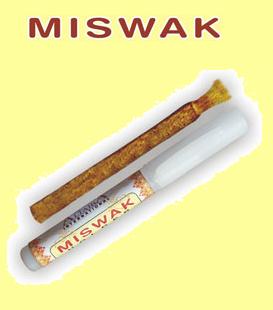
Miswak In Islam

A 2003 scientific study comparing the use of miswak with ordinary toothbrushes concluded that the results clearly were in favor of the users who had been using the miswaak, provided they had been given proper instruction in how to brush using it. The World Health Organization (WHO) recommended the use of the miswaak in 1986 and in 2000 an international consensus report on oral hygiene concluded that further research was needed to document the effect of the miswak.
Prophet Mohammed (pbuh) recommended its use.


Narrated Abu Huraira(RA):
Allah’s Apostle(pbuh) said, “Were I not afraid that it would be hard on my followers, I would order them to use the siwak (as obligatory, for cleaning the teeth) Volume 9, Book 90, Number 346:Sahih Bukhari
Narrated Hudhaifa(RA) :
Whenever the Prophet(pbuh) got up for Tahajjud prayer he used to clean his mouth (and teeth) with Siwak. Volume 2, Book 21, Number 237: Sahih Bukhari
Abu Hurayrah (RA), who reported that the Prophet (peace and blessings of Allaah be upon him) said: “Were it not for the fact that I did not want to make things too hard for my ummah, I would have commanded them to use the siwaak at every time of prayer.” (Reported by al-Bukhaari, 2/299 and Muslim, 1/151).
Allah knows the best.

Friday, September 30, 2011

A Summary of the Economic Law of Islam

The economic law of Islam given to man by the Almighty through His last Prophet for the purification of the economy is based on the Qur'anic philosophy of creation: the Almighty has created this world as a trial and test for man; every person has therefore been made to depend on others for his living. No one in this world can live independently as regards his needs and requirements. A person of the highest rank turns to the most ordinary to fulfill them. In other words, every single person has an important role to play, without which this world cannot continue. This role depends upon his abilities, intelligence and inclinations as well as upon his means and resources, which vary from person to person. In fact, it is because of this variation that a society comes into being. Consequently, laborers and workers, artisans and craftsmen, tillers and peasants are as indispensable as scholars and thinkers, savants and sages, leaders and rulers. Every individual is an integral component of the society and contributes to its formation according to his abilities. The Qur'an says:

We have apportioned among them their livelihood in this world [in such a manner that]
We have exalted some in status above others so that they can mutually serve each other.
And better is thy Lord's mercy than what they are amassing. (43:32) 
      By creating various classes of people, the Almighty is testing whether the big and the small, the high and the low create a society based on co-operation and respect or create disorder in the world by disregarding the role each person has been ordained to play. The latter attitude would, of course, lead them to humiliation in this world and to a grievous doom in the Hereafter. The Qur'an says:

We are trying you by giving you happiness and sorrow, to test you, and unto Us you will be returned. (21:35) 
    It is to salvage man in this trial that the Almighty has guided man through His Prophets and revealed this economic law to cleanse and purify him. The following is a summary of this law: 
    1. Zakat:  It is obligatory upon a Muslim to pay zakat from his wealth, produce and livestock if he is liable to it.
    2. Sanctity of Ownership:  If a Muslim has paid his zakat dues, then his rightfully owned wealth cannot be usurped or tampered with in any way, except if on account of some violation by him, the Shari'ah endorses it. So much so that an Islamic State has no authority to impose any tax other than zakat on its Muslim citizens.
    3. Establishment of a Public Sector:  For the just distribution of wealth, the establishment of a public sector is essential. Consequently, everything which is not, or cannot be owned by an individual should in all cases remain in the ownership of the state.
    4. Incompetence:  Since a person's way of using his wealth and property also influences the development and welfare of a society, the state has the right to deprive him from using them, while acknowledging him to be the owner, if he is proved to be incompetent .
    5. Usurpation:  It is prohibited to devour other people's wealth and property by unjust means. Illegal gratification, gambling and interest are some horrendous forms of usurpation. Other economic activities should also stand permissible  or prohibited in the light of this principle.
    6. Evidence and Documentation:  In affairs such as financial transactions and making a will and acquiring a loan, the parties involved should write down a document and call in witnesses to safeguard against any moral misconduct by either of the parties.
    7. Distribution of Inheritance:  The wealth of every Muslim must necessarily be distributed after his death among his heirs in the following manner: 
If the deceased has outstanding debts to his name, then first of all they should be paid off. After this, any legacies he may have bequeathed should be paid. The distribution of his inheritance should then follow.  After giving the parents and the spouses their shares, the children are the heirs of the remaining inheritance. If the deceased does not have any male offspring and there are only two or more girls among the children, then they shall receive two thirds of the inheritance left over, and if there is only a single girl, her share is one half. If the deceased has only male children all his wealth shall be distributed among them. If he leaves behind both boys and girls, then the share of each boy shall be equal to the share of two girls and, in this case also, all his wealth shall be distributed among them. 
In the absence of children, a deceased's brothers and sisters shall take their place. After giving the parents and spouses their shares, the brothers and sisters shall be his heirs. The proportion of their shares and the mode of distribution shall be the same as that of the children stated above.  If a deceased has brothers and sisters, whether he has children or not, the parents shall receive a sixth each. If he does not even have brothers and sisters, then after giving the husband or wife his (or her) share, one third of what remains shall be given to the mother and two thirds to the father. If there is no one among the spouses, all of the inheritance shall be distributed among the parents in this same proportion.  If the deceased is a man and he has children, his wife shall receive one eighth of what he leaves, and if he does not have any children, his wife's share shall be one fourth. If the deceased is a woman and does not have any children, then her husband shall receive one half of what she leaves and if she has children, the husband's share is one fourth. 
Together with these rightful heirs, after them or in their absence a deceased can make a near or a distant relative except his parents and children an heir. If the relative who is made an heir has one brother or one sister, then they shall be given a sixth of his share and he himself shall receive the remaining five sixth. However, if he has more than one brother or sister then, they shall be given a third of his share and he himself shall receive the remaining two thirds.  If a person dies without making anyone his heir, his remaining legacy shall be distributed among his male relatives according to the principle 'closest to the next closer'. 
    ____________ 
This is the law the Almighty has revealed to us to purify our economic dealings. While following this law in letter and in spirit, a person may encounter financial difficulties, and he may have to sacrifice his interests. The real reward for this is the kingdom of heaven which the Almighty will grant him on the Day of Judgment. However, He has promised that if the Muslims in their collective capacity adhere to faith and adopt a God-fearing attitude, the Almighty shall provide them abundantly in this world as well: 
Had the people of these cities accepted faith and kept from evil,
We would have showered the blessings of the heavens and the earth upon them.
But they rejected [the truth] and [so] We punished them for their misdeeds. (7:96) 
According to the Qur'an, the Prophet Noah (sws) recounted this established practice of the Almighty in the following words: 
    I said to them: Ask forgiveness from your Lord. He is oft-forgiving. [As a result], He shall send rain upon you in abundance and give you increase in wealth and children and bestow on you gardens and shall bring forth for you springs of water. (71:10-12) 
    This what the Old Testament says in this regard: 
    And it shall come to pass, if thou shall hearken diligently unto the voice of the Lord thy God, to observe and to do all his commandments which I command this day, the Lord thy God will set thee on high above all nations of the earth: and all these blessings shall come on thee, if thou shall hearken unto the voice of the Lord thy God. Blessed shall thou be in the city, and blessed shall thou be in the field. Blessed shall be the fruit of thy body, and the fruit of thy ground, and the fruit of thy cattle, the increase of thy kin, and the flocks of thy sheep. Blessed shall be thy basket and thy store. Blessed shall thou be when thou comest in, and blessed shall thou be when thou goest out. (Deuteronomy, 28:1-7)

Medina Charter of Prophet Muhammad and Pluralism

The original Madina Charter document does not exist but the most widely read version of the Constitution is found in the pages of Ibn Ishaq's Sirah Rasul Allah (For English translation of the full text see wikisource), 
The clash of civilizations, cultures, tribes, and religions seems to be prevalent throughout all of history. At the same time, history reveals simultaneous conflict and efforts to resolve tensions and division feeding animosity through mediation, diplomacy, and dialogue. Many conflicts seem too complicated for an agreement to be established on just one point, whether or not the conflict revolves around territory, religion, or ethnic discrimination. So what approach is best to mediate issues in a contemporary world that seems to be driven by economics, natural resources, and ethnic or religious ideologies? The Medina Charter serves as an example of finding resolve in a dispute where peace and pluralism were achieved not through military successes or ulterior motives but rather through respect, acceptance, and denunciation of war - aspects that reflect some of the basic tenets of the religion Prophet Muhammad, peace be upon him, was guiding and promoting. Through an examination of the Medina Charter, I will show how pluralism was advanced and instated in Medina and the reasons reflecting on such a document could help avoid the divide and misunderstanding plaguing much thought, rhetoric, and media today between Muslims, Christians, and Jews all over the world.

When the Prophet was forced to immigrate to Medina, the population was "a mixture" (akhlat) of many different tribes (predominantly Arabic and Jewish), who had been fighting for nearly a century, causing "civil strife," and it was for this reason that the Prophet was summoned there (Peters 1994, 4). Tribal fighting and a lack of governance in Medina (known as Yathrib) meant disputes were dealt with "by the blade" on many occasions, which deepened the divides and fueled conflicts. Karen Armstrong explains aptly the mentality and workings of the tribal system dispersed through war-torn Arabia, where the Prophet was striving for peace (Armstrong 2006, 19). "The tribe, not a deity, was of supreme value, and each member had to subordinate his or her personal needs and desires to the well-being of the group and to fight to the death, if necessary, to ensure its survival" (Armstrong 2006, 24). Such a system was, in a political sense, representative of the little cooperation between the tribes in the Yathrib. In this region reigned power hungry strategies, an emphasis on arms and strength in military, and a belief that clearly mediation was unachievable except by a trustworthy outsider who had no connections to the issues or the tribes. Not only did the Prophet fit these prerequisites, but his personal ambition as given to him by God was also one of spreading peace and unity, creating a community, or ummah, made up of diverse groups, through the teachings of the Quran and in the name of Islam.

The Quran states that the Lord "teaches by the pen" (96:1-5). This is indicative of the Medina Charter in that it is a reflection of these verses, which show that God is educating people and changing thought patterns through discussion. In this case, the discussion resulted in peace achieved through contemplation and through seeking agreements in which tribes felt they had benefited from the charter and had not been robbed of status or unresolved antagonism from the past. "Many Islamic rituals, philosophies, doctrines, [different interpretations of] sacred texts, and shrines are the result of frequently anguished and self-critical contemplation of the political events in Islamic society" (Armstrong 2006, 14). Islam places great emphasis on reason - the reasoning of the universe, of life, and indeed, of religion too. Al-Ghazzali (1058-1111) said, "Doubt is to find truth. Those who do not have doubt cannot think. Those who cannot think, cannot find truth." Although this quote is more in reference to the philosophical side of Islam, it reverberates from the heart of reason - something that is central to Islam. Yetkin Yildirim writes about the use of one's own knowledge and the absolute approach of reason. If the answer is neither in the Quran, Sunnah, or Hadith, then one's own reasoning or ijtihad is required (Yildirim 2006, 109-117). So the Prophet, through the Medina Charter, was practicing Islam through action. For with reason, discussion, and contemplation, a peace treaty was created.

Quba Mosque in Madina. Considered to be the first Mosque in Islam. Date of photo unknown
The mere formation of the Charter and peace were tremendous feats, and the content of the Charter itself reflects this magnitude. The formation of an ummah through respect and acceptance resulting in pluralism shows us one of the ways in which the Prophet combated jahiliyyah, or ignorance - the state of mind causing violence and terror (Armstrong 2006, 19). Examining some of the clauses in the Charter also shows how the Prophet managed to take leadership and create a lasting peace. The first clause, "They are a single community (ummah)," (Sajoo 2009, 94) depicts the ultimate message and goal of the rest of the charter. It marked the creation of a community, and the Charter served as a unifying document in a city of diverse groups, cultures, religions, and languages. The Prophet came to Medina with tolerance - an aspect of Islam which is fundamental to the manner in which the religion operates in foreign lands. "It is for this tolerance in the Islamic view that Muslims have looked at the religion of the people in the lands they conquered with respect; they did not intervene with their beliefs nor touch their churches" (Can 2005, 172). Clause 25 epitomizes the level of tolerance in the charter and also serves as an example of Islam in practice. "The Jews ... are a community (ummah) along with the believers. To the Jews their religion (din) and to the Muslims their religion" (Sajoo 2009, 96) This statement ties in with the verse from the Quran (2:256) which says, "There is no compulsion in religion." For in the eyes of God, as it says in the Quran "... those who believe ... Jews, Christians, and Sabaeans ... and does right - surely their reward is with their Lord" (2:62).

The Medina Charter reflects pluralism both in the content and in the history of the document. F. E. Peters explains that "the contracting parties, although they did not embrace Islam, did recognize the Prophet's authority, accepting him as the community leader and abiding by his political judgments" (Peters 1994, 199). As there is no account of an uprising in history books and because the Prophet was there at the suggestion of the tribes, we know that he was never rejected. Because of the laws he introduced, the existing groups clearly did not feel threatened by his new presence or his new governance. The society was pluralistic, and it was not repressive. The Prophet - as clause 25 shows - never imposed Islam upon the people of Medina, which meant that they could still practice without disruption their religions and customs, aspects of life that were important to them. He did not create an ummah through denouncing all ways of life except for Islam or by recognizing Islam as the singular religion; instead he united all inhabitants of the city under one banner of ethical living and moral principles - commonalities between all humans and all religions.

The Prophet drew upon the essence of unity, respect, tolerance, and love to combine and create a pluralistic community. Clause 40 exemplifies this: "The 'protected neighbor' (jar) is as the man himself so long as he does no harm and does not act treacherously" (Sajoo 2009, 97). People were safe and respected and free to exert their beliefs and would be protected in doing so. This protection, however, could not shield them from treachery or wrong doing.

The Medina Charter is arguably the first constitution ever written incorporating religion and politics (Yildirim 2006, 109-117). And even though the politics of the region have changed since it was written - in recent times for the worst - Islam's values have continued to spread and are lived throughout the whole Muslim world. Despite the hold of power that some governments still have over their people, the true face of Islam shines through in how people live, communicate, and approach life. I speak from personal experiences when I traveled through Iran, Turkey, and Northern Iraq in January, 2009. And despite what the media had to say about the people in those lands, my time there was spent in the houses of complete strangers, who showered me with hospitality that transcended any I had experienced before. Although the governing body has changed, the points of the Medina Charter and tenets of Islam preached by Prophet Muhammad still exist amongst the people. My heritage was accepted with curiosity and respect - just as the Prophet implemented in Medina between the tribes. My place in the society was welcomed with honest enthusiasm, and I felt a part of a community - like the community that Prophet implemented in Medina. I was exposed to mainstream Islam, which we hear so little about in the West due to the confusion which unjustly joins Islam and extremism together. I saw tolerant Muslims who saw me as another person who wanted peace and respect - not treachery. This is what the Prophet also accomplished in Medina - a community which was not based upon religion or ethnicity but one built on unity and acceptance. One built on tolerance. One built on peace. It seems the Prophet was aware that spirituality and faith cannot be governed, and for this reason alone, he sought unity and respect as opposed to discriminating between tribes and their beliefs.

In contemporary times, an analysis of the Medina Charter can give us insight into Islam and religious pluralism (Sachedina 2001). Medina marked the first real occurrence of coexistence between religions and groups in Islam and mirrors the Quran which "in its entirety provides ample material for extrapolating a pluralistic and inclusive theology of religions" (Sachedina 2001, 26). The Quran is the unquestionable and the absolute; therefore, it is the key to understanding religious pluralism in Islam. Clause 39 of the Medina Charter says, "The valley of Yathrib is sacred for the people of this document" (Sajoo 2009, 97). And so too is the universe, which is sacred to all of humanity. The Quran reveals that "the people are one community" (2:213), so if we are one (which we are) in the world, in the universe, then regardless of religion, it is God's mercy and compassion which will save us. By differentiating between beliefs, we neglect that under one sun we all pray to a greater entity, a greater being. We were all created by God, so unity seems imperative and practical.

The Medina Charter is very relevant to current tensions existing between the Muslims, Jews, and Christians. Unfortunately, it seems that ignorance and fear, suspicion and disrespect plague the interaction and stereotypes that exist between these three great Abrahamic religions. In the post-September 11th era, a new wave of antagonism has arisen, and people around the Western world generally fear Islam. Sadly, people confuse the actions of nationalists and fundamentalists, who so unjustly hide behind a Holy Book claiming that their intentions are those of God, with what the actual religion promotes. As Rumi believed, the essence of all religions is the same, for they all teach love. The deep philosophical and even deeper spiritual teaching of Rumi is based on a state of mind that seeks mutual vision and dialogue, which I hope will be achieved one day, breaking down the polarized world of different religious thought. Another verse of the Quran emphasizes this need for dialogue, unity, and tolerance: "Surely this community of yours is one community, and I am your Lord; so worship Me" (21:92).

The Prophets action's in Medina prompt us to use reason in our approach to the wide, diverse beliefs of the world - from Europe to Asia, North, Central, and South America to Africa and everything in between. It prompts us to understand how "the spiritual space of the Quran [...] was shared by other religions" (Sachedina 2001, 23). Such an understanding reveals that Islam is a monotheistic religion that respects the rights of other faiths (Stewart 1994, 207). In a globalized world where we are connected so easily, unlike any other period in history, our mutual understanding of one another and our beliefs are the most important means to achieve peace and stability. It is in a contemporary sense, in a globalized world, that the Medina Charter is of such necessity. Inter-religious discussions took place with the Prophet in Medina, for Boase writes about a time when Christians performed their prayers in a mosque after a meeting with the Prophet during their visit (Boase 2005, 252). We can learn how in every country, a community, an ummah, is the single most effective way to produce a pluralistic state. The Medina Charter was a fusion of attributes which all world religions teach: peace, love, freedom, acceptance, and tolerance - resulting in stability.

Peace was achieved in Medina, not through the might of arms or the scale of wealth, but through the unyielding principles of Islam - tolerance, love, reason, and a belief in God - whether the God in the Bible, the Quran, or the Torah. The Medina Charter, arguably the first charter ever written, shows that Islam rejects the use of compulsion in religion and violence and that over centuries of human existence, the most effective way to resolve conflicts comes through mediation. The Medina Charter is an example that should be discussed and referred to in current conflicts. The creation of a community, or ummah, offers pluralism to everyone. For people are not judged on their beliefs, but on their actions. Persecution is the instigator of all tensions, and reason and tolerance is the essence of all peace. Just as in the streets of Medina, through tolerance and respect, we too may one day have a world-wide ummah, where a passing Christian will say, "Peace be upon you" to a Muslim, who will reply, "Peace be upon you too."


Sean William White has a degree in Islamic history from Monash University, Melbourne.
References
  • Armstrong, Karen. 2006. Muhammad: A Prophet for Our Time, New York: HarperCollins.
  • Can, Sefik. 2005. Fundamentals of Rumi's Thought, New Jersey: The Light, Inc.
  • Lecker, Michael. "Waqidi's Account on the Status of the Jews of Medina: A Study of a Combined Report," in Uri Rubin (ed), The Life of Muhammad, Great Yarmouth, 1998.
  • Peters, F. E. 1994. Muhammad and the Origins of Islam, New York: SUNY.
  • Ramadan, Tariq. 2007. The Messenger: The Meanings of the Life of Muhammad, London: Allen Lane.
  • Boase, Roger. Ecumenical Islam: A Muslim Response to Religious Pluralism, in Roger Boase (ed.). 2005.
  • Islam and Global Dialogue, England, Ashgate.
  • Sachedina, Abdulaziz. 2001. The Islamic Roots of Democratic Pluralism, New York: OUP.
  • Saeed, Abdullah. 2006. Islamic Thought: An Introduction, UK: Routledge.
  • Sajoo, Amyn B. 2009. Muslim Ethics: Emerging Vistas, London: Institute for Ismaili Studies.
  • Stewart, P. J. Unfolding Islam, Lebanon, 1994.
  • Yildirim, Yetkin. "Peace and Conflict Resolution in the Medina Charter," Peace Review, UK: Routledge, Vol. 18, Issue 1. January 2006.

Notes
  1. Muhammad B. Waqidi, 'Umar al-Waqidi. Kitab al maghazi. Ed. M. Jones. London, 1966, as taken from: Michael Lecker, 'Waqidi's Account on the Status of the Jews of Medina: A Study of a Com- bined Report', in Uri Rubin (ed), The Life of Mu-hammad, Great Yarmouth, 1998, p. 23.
  2. www.ghazali.org

Source: The Fountain Magazine

Islamic banking setting new standards in the Persian Gulf countries


                                       Since a few months, there has been a sudden rise in the Islamic loan market pertaining to the Persian Gulf countries. The investors in the Persian Gulf countries sold sukuk bonds that had inferior debt ratings so that they could elevate money for issuing even further sukuk bonds which are backed by the state. With the growth of the Islamic banking and investment in the Persian Gulf countries, an increased number of people are investing in the Islamic bonds and earning huge returns that are utilized in paying debt help services.

There is a sudden widespread in Islamic finance and due to the vast returns from Islamic bond investment, there is also a simultaneous increase in the number of investors getting lured towards investment in the sukuk or the main financial instrument of the Islamic finance. According to a survey, it has been predicted that there will be a sale of Islamic bonds that may have risen to $1.5 billion in November and this will perhaps be the highest till record. Such encouraging statistics is prompting more investors to keep on investing in those countries that allow Islamic finance.

As per a recent report, a Jeddah-based Islamic bank in the Persian Gulf has already sold $500 million of sukuk and this has set an entire new standard for the Islamic finances. In the United Arab Emirates, Abu Dhabi Islamic bank, that is perhaps the next after the largest Islamic banks, is also foreseen to raise $1 billion debt for sale. All these offerings taken together could fetch an amount of $2.5 billion from all the Islamic financial institutions taken together.


There are some other banks in the Persian Gulf that are trying to match with the present state of the Islamic economy. The countries who are a member of the Gulf Cooperation Council (GCC) have increased the sale of Islamic bonds after the treaty signed by Dubai World. According to this agreement, it was decided that 98% of all creditors will revise their rules and regulations on their borrowings that amounts to $24.9 billion and lessen the risk of defaulting. With such positive financial improvements, economic growth in the Persian Gulf countries are expected to rise to 4.2% in 2010 that is an increase by 2% in the last year.

Therefore, it is quite evident that with the growth of the Islamic bond market, more consumers and investors can invest in sukuk and utilize the proceeds in paying off debt help services. The Islamic debt market has improved in the context of the global financial market and which such a dependable rate of increase, it will keep on attracting investors and generating enough revenue for the countries.
*****
Rose Anderson is a financial writer. She is the Community Member of "Debt Community" and has been contributing her suggestions to the Community. She has also made notable contributions through various articles written on different subjects related to the debt industry.